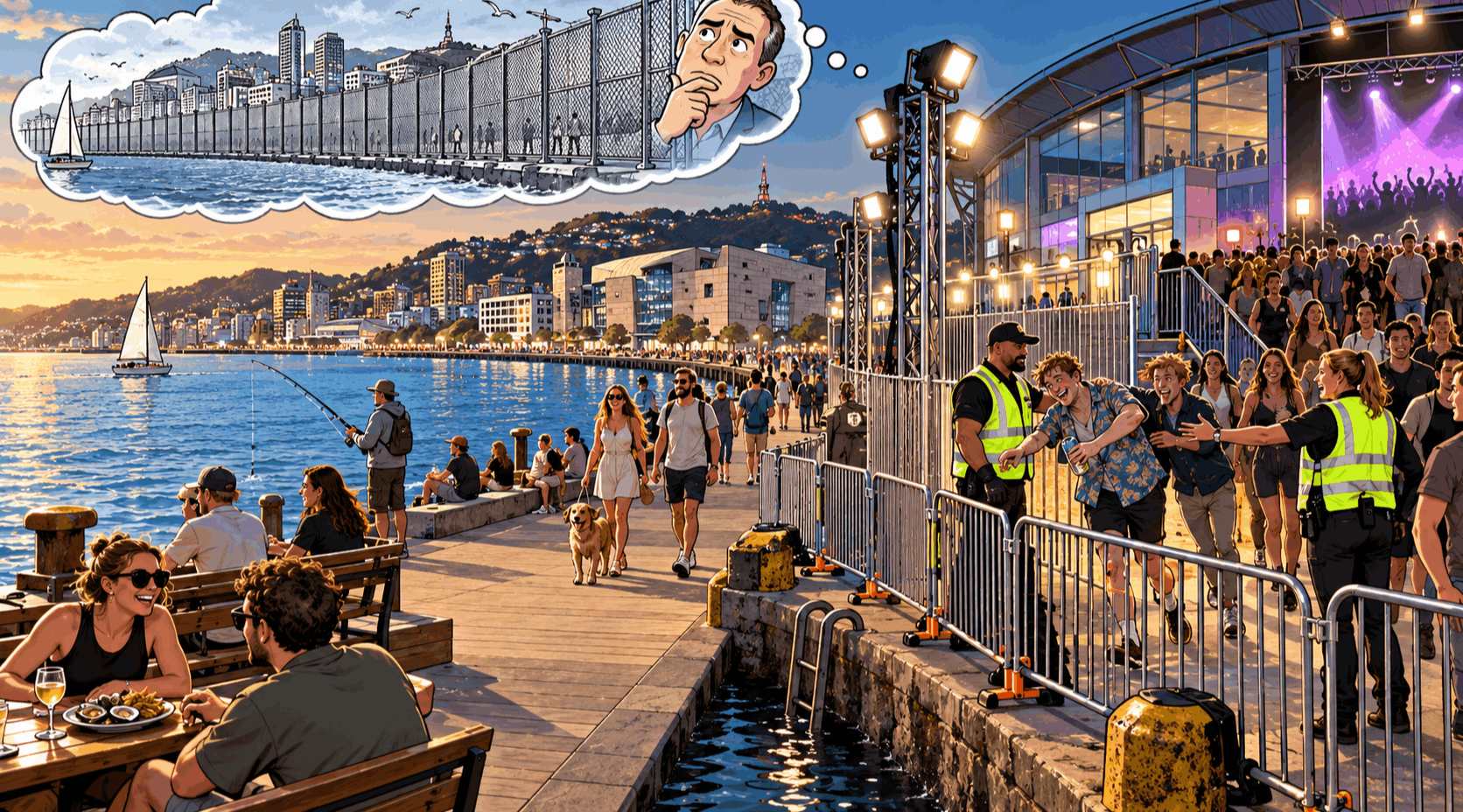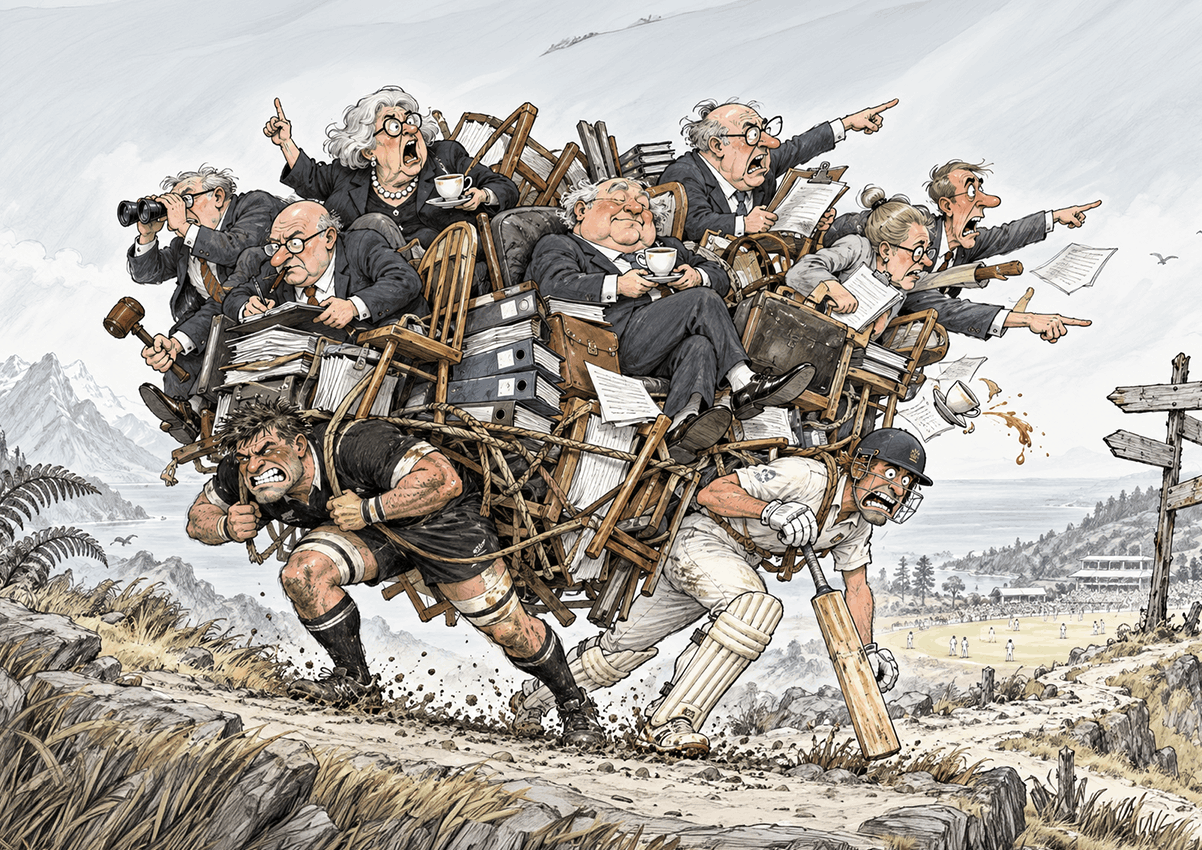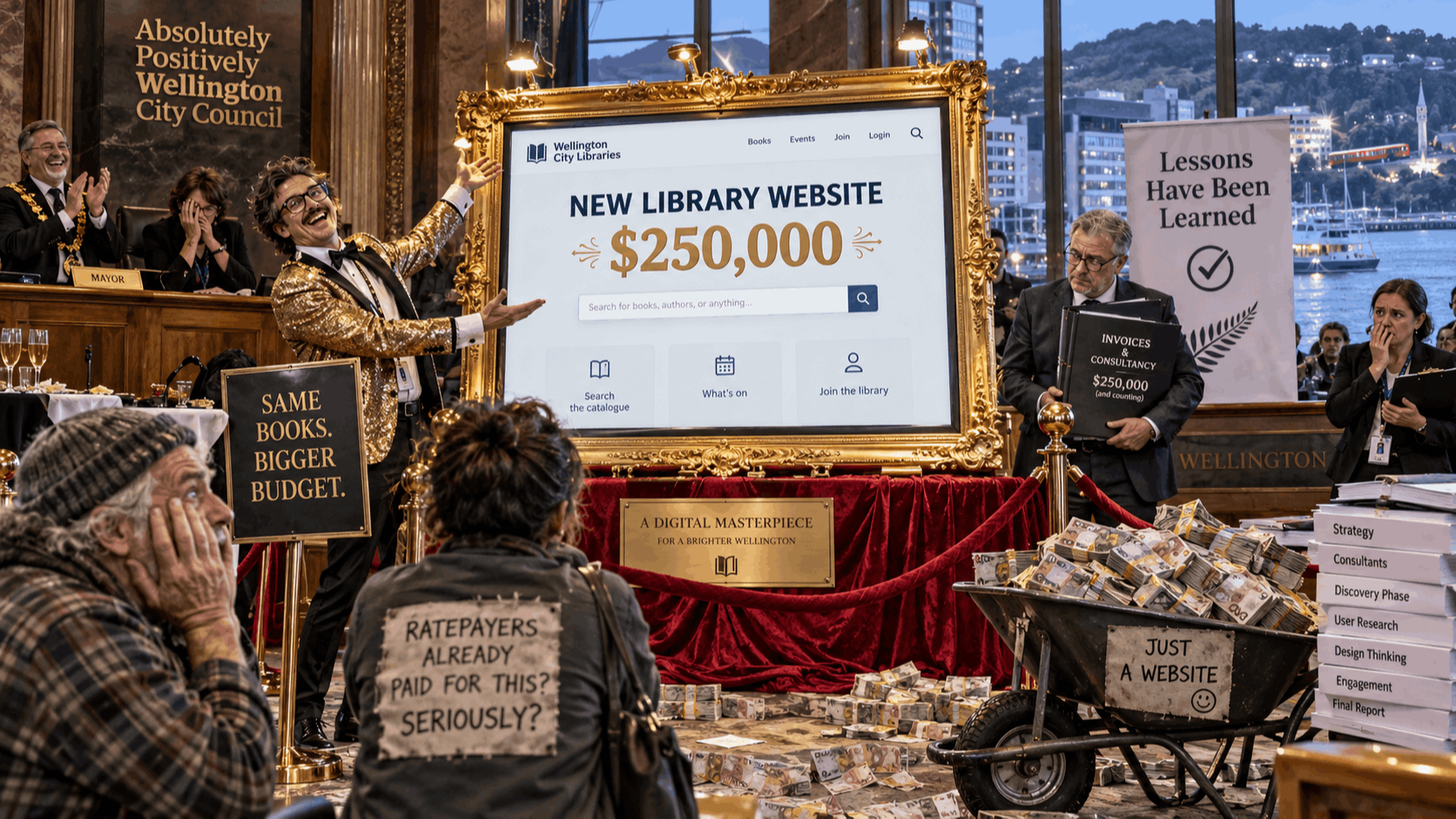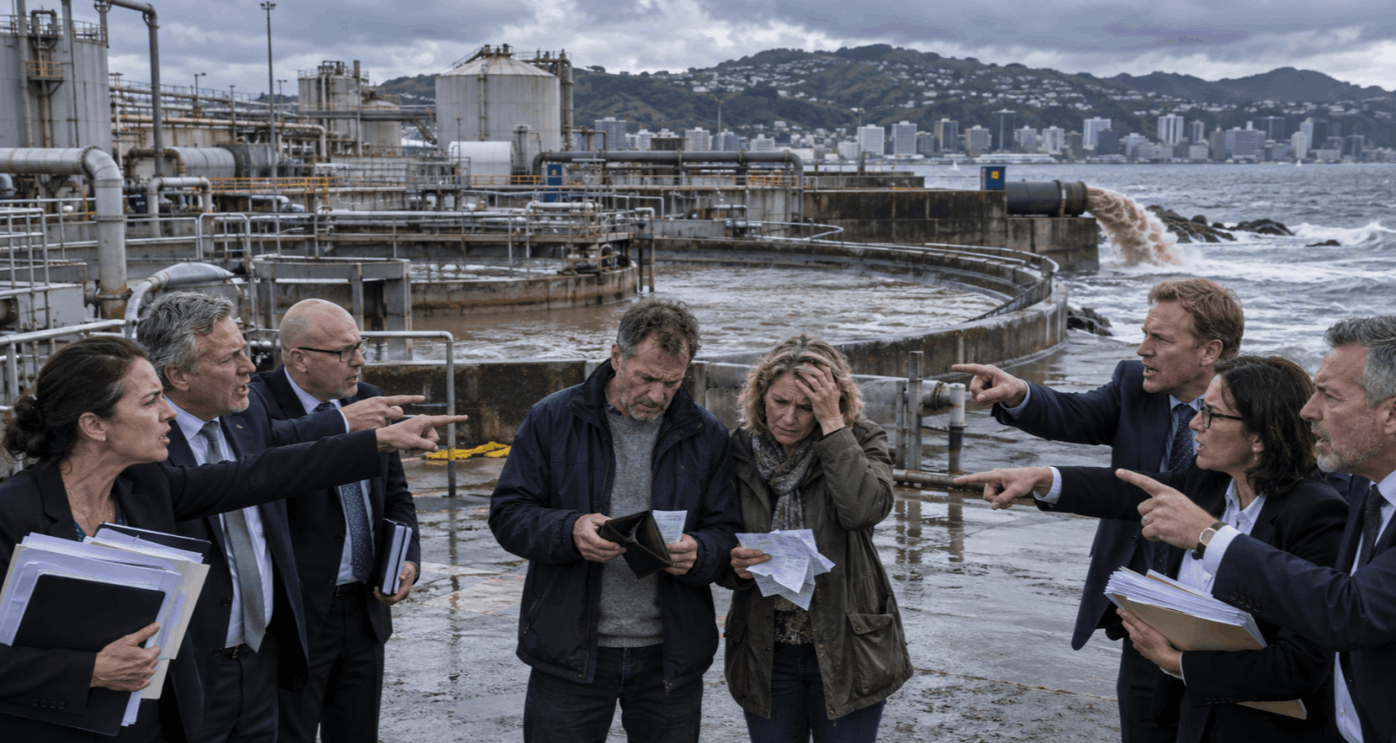


For years, Wellington has treated its entertainment heart like an inconvenient hallway between council meetings. Plans have been written. Reports have been commissioned. Diagrams have been coloured in. Consultants have consulted other consultants. Meanwhile, the street that should be the city’s neon pulse has been allowed to drift into a tired strip of empty promises, nervous retailers, wounded hospitality operators, and Friday-night sadness in a hi-vis vest.
The Golden Mile project may have collapsed under the weight of its own price tag, but the deeper failure is not financial. It is imaginative.
Wellington’s problem is not that Courtenay Place is impossible to fix. It is that the people charged with fixing it have tried to solve a cultural, entertainment, tourism and hospitality problem as though it were a footpath-management exercise.
That was never going to work.
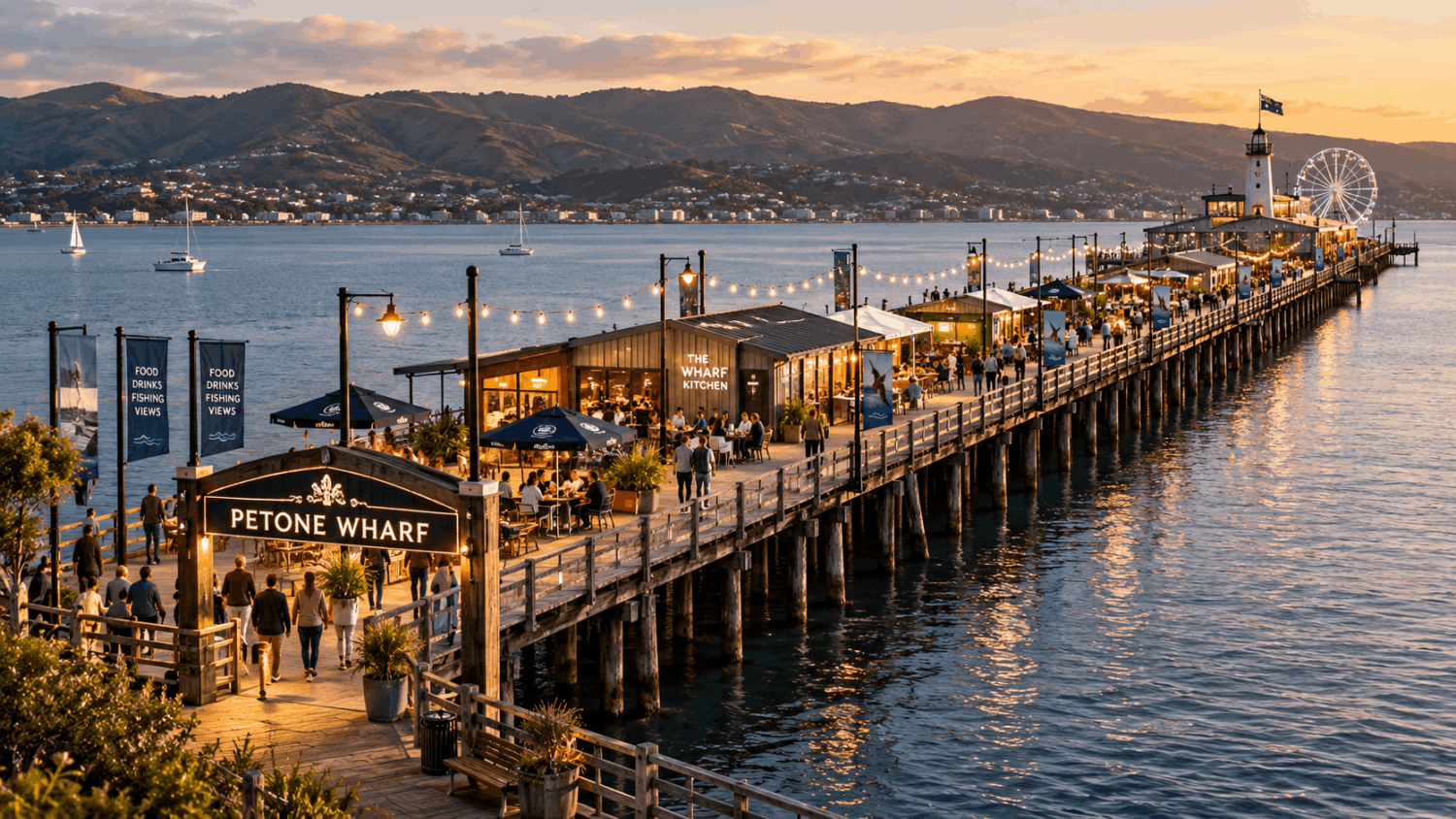
Courtenay Place should be the capital’s front room. It should be loud, lit, safe, creative, surprising, hungry, musical, theatrical and unapologetically alive. It should be the place where visitors go first, locals return often, and dullness goes to die quietly behind a policy document.
Instead, we have had the usual Wellington disease: bureaucratic caution dressed up as strategy.
Council officers have been out of their depth. Not because they are bad people, but because this is not a job for pavement technicians, transport modellers and risk-averse memo writers. Reviving Courtenay Place requires showmanship, commercial instinct, event experience, hospitality knowledge, retail realism, design flair, and the ability to make people want to be somewhere.
That is a very different skill set from producing a 90-page report nobody reads unless trapped in a lift.
The retailers and hospitality operators are exhausted. They are not short of concern. They are short of leadership. Many are running in circles because the city around them has no clear destination. You cannot build confidence on vibes, parking anxiety, broken windows, and another roundtable at 4pm with lukewarm muffins.
And as for the worthy organisations that gather under grand names and civic concern — Vision for Wellington and the rest — enough with the highbrow talk-fests. Wellington does not need another room full of clever people agreeing that something must be done. Wellington needs the people who know how to do things.
Courtenay Place needs a producer.
Not a project manager. Not a panel. Not a stakeholder journey. A producer.
Someone, or a small team, with authority to curate the street as an experience. Lighting. Music. Street performance. Late-night safety. Outdoor dining. Pop-up stages. Weekend themes. Laneway activations. Food, comedy, jazz, theatre, art, short festivals, student nights, family afternoons, winter fire-and-food events, film tie-ins, sports screenings, design markets, buskers, projections, murals, and reasons — actual reasons — for people to come into town.
Start small if necessary, but start visibly.
Paint something. Light something. Open something. Book something. Clean something. Close one side street for a weekend and make it sing. Put a stage where the silence is. Put food where the fear is. Put colour where the council has left beige.
Courtenay Place does not need to become Ponsonby, Cuba Street, Melbourne, Copenhagen or some urbanist’s wet dream with imported cobblestones. It needs to become the best version of itself: Wellington’s entertainment spine, theatre strip, food strip, after-dark strip, visitor strip, student strip, event strip, and mischief strip.
Stuff's Dave Armstrong in a recent article, may see civic malaise. MEGA sees an opportunity wearing bad shoes.
Yes, Wellington has problems. Homelessness, safety, public confidence, retail decline, cost pressures, transport confusion, political caution, and the ever-present threat of another committee forming in the shrubbery. But none of that is a reason to give up. It is the reason to act faster.
The answer is not to mourn the Golden Mile. The answer is to replace it with something sharper, cheaper, faster, braver and more human.
Create a Courtenay Revival Taskforce — not a talk shop, not a council subcommittee, not a taxpayer-funded therapy circle. A compact delivery group of event people, hospitality people, retailers, police, safety experts, property owners, artists, designers, promoters, students and council decision-makers who are allowed to say yes.
Give it 100 days.
Not three years. Not after the next election. Not once the strategic alignment framework has finished mating with the urban mobility review.
One hundred days.
In that time, clean the street, light the dark spots, remove dead frontage, incentivise pop-ups, create weekend programming, introduce visible safety support, support outdoor trading, cut red tape, fill empty windows, and give Wellingtonians a reason to come back.
Then keep going.
Courtenay Place does not need pity. It needs ambition.
It needs less Wellington hand-wringing and more Wellington spine.
It needs a kick in the behind, a splash of paint, a calendar full of reasons, and a city council that finally understands that streets are not revived by managing decline.
They are revived by creating life.
Mayor Ken Laban appears to have discovered a bold new position on Super Cities: one foot in, one foot out, shake it all about, then ask the community what they think before the music stops.
On one hand, he is open to local government reform, fewer duplicated services, better regional coordination, and the possibility that the current council jungle may need a serious pruning.
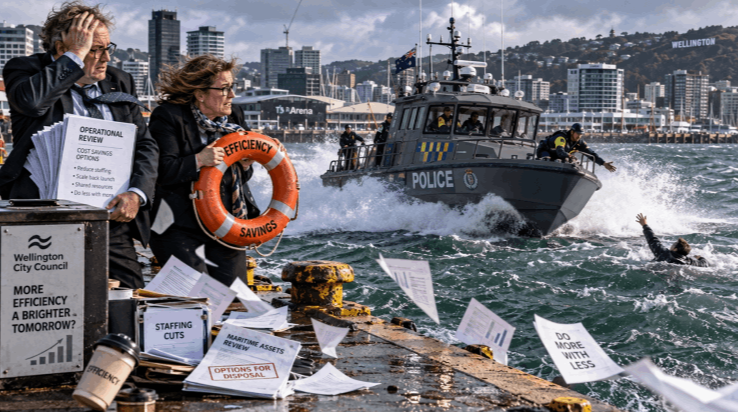
On the other hand, he warns against Lower Hutt being swallowed into a faceless regional blob where local voice, local identity, and local accountability are quietly placed in a recycling bin marked “efficiency”.
Fair enough. Reform is complicated.
But here is the problem: the message is starting to sound less like leadership and more like someone trying to pat both sides of a very large political dog.
Are we exploring amalgamation, opposing amalgamation, welcoming the conversation, warning against the outcome, backing a Hutt Valley solution, rejecting a Wellington Super City, or simply standing in the middle of the road waving two different flags?
Lower Hutt residents deserve clarity.
If the mayor believes a combined Hutt Valley council is worth serious investigation, say so clearly. If he believes a Wellington-wide Super City is a threat to local democracy, say that clearly too. But do not wrap both positions in so much cautious language that ratepayers need a decoder ring and a thermos.
The danger is not that Laban is asking questions. Questions are good. The danger is that the answers appear to change depending on which audience is listening.
MEGA’s view is simple: reform should not be feared, but nor should it be smuggled in under the polite carpet of “efficiencies”. If councils are bloated, say it. If regional coordination is broken, say it. If Wellington wants to swallow the Hutt, say “hands off our sausage rolls” and mean it.
The Hutt should not become a suburb of Wellington’s paperwork.
Ken Laban is right that the future belongs to the people. But the people need to know what future he is actually pointing at.
At the moment, the signal from the mayoral office is not red, green, or amber.
It is flashing disco.
There is something deeply wrong when Government event funding appears to be flowing toward major overseas promoters and international acts who do not need the money, while local promoters — the people actually building the New Zealand industry from the ground up — are left to survive under a completely different set of rules.
The Government’s major events fund is being sold as an economic development tool. In theory, that sounds sensible. Bring in big acts, fill hotels, sell drinks, move taxis, make Auckland look alive for a night. Fine. Nobody is against major events. Nobody is against international artists coming here.
But here is the problem: why are taxpayers helping underwrite global entertainment machines that already have the commercial muscle, ticketing power, sponsorship reach, and international infrastructure to stand on their own two feet?
Post Malone does not need New Zealand taxpayers. Nor do the overseas promoters who bring these acts down here. These are not struggling artists with a guitar case outside a railway station. These are highly commercial operations with ticket prices that can run into hundreds of dollars. If the show stacks up commercially, run it. If it does not, do not run it. That is called business.
Local promoters understand risk. We live with it every day. You put your house, reputation, suppliers, crew, and bank balance on the line before a single ticket is torn. You pay deposits. You book venues. You market the show. You carry the dead nights as well as the glory nights.
So if the Government genuinely wants to support major events, there is a fairer model: underwrite the event setup, then recover the money once the event succeeds.
That is not a handout. That is a bridge.
Help with the upfront risk where needed — venue bonds, production deposits, marketing commitments, infrastructure costs — and if the show sells, the taxpayer gets paid back. Simple. Clean. Fair. It encourages ambition without turning public money into a lolly scramble for people who already have deeper pockets than the local industry.
But the Minister seems to be ignoring that formula.
Instead, we get a system that looks opaque, selective, and tilted toward the already powerful. Overseas promoters get courted. International names get polished announcements. Meanwhile local promoters, who actually live here, employ local people, use local suppliers, and keep the machine alive between headline acts, are told to hustle harder.
And then we have the arts sector crying foul because cultural agencies are being cut.
Some of that criticism is fair. Some community arts funding does good work. Some regional arts projects create real value. But there is also an uncomfortable truth the arts lobby does not like hearing: artists chose this career.
Singers chose to sing. Actors chose to act. Dancers chose to dance. Performers chose to perform. Just like a plumber chose plumbing, a lawyer chose law, a chef chose the kitchen, or a small business owner chose the daily terror of GST, wages, rent, and customers who think “exposure” pays invoices.
Why is one career path automatically treated as morally entitled to taxpayer support?
A plumber does not get a Creative Pipefitting Grant because the market is difficult. A café owner does not get a cultural resilience fund because Tuesday lunch was quiet. A concert promoter does not get rescued when ticket sales die like a possum on State Highway 1. They rise or fall on their effort, judgement, product, discipline, and ability to find an audience.
Artists should not be exempt from that reality.
If the work is good, build an audience. If the audience is small, adapt. If the model does not work, change it. That is not cruelty. That is life. Every private-sector worker and business owner already lives under those rules.
The arts sector often talks as if public funding is a birthright. It is not. It is taxpayer money. It comes from people who got up, worked, paid tax, and may never attend the show, visit the gallery, or benefit from the programme. That money should be treated with more respect than a convenient subsidy for professional self-expression.
The same standard should apply to major events.
If public money is used, there must be a measurable public return. Not vague “vibrancy”. Not press-release fairy floss. Not a photo opportunity with a minister standing near a lighting rig. Real return. Hotel nights. Visitor spend. Local employment. Supplier contracts. Regional benefit. And where possible, repayment when the event succeeds.
That is the key difference between investment and indulgence.
New Zealand should absolutely have a thriving events industry. We should bring in major acts. We should back local promoters. We should support events that generate genuine economic activity. But we should stop pretending every cheque written in the name of “culture” or “major events” is automatically noble.
At the moment, the system looks backwards.
The people who need intelligent risk support are local operators. The people who should be standing on their own are wealthy international touring operations. And the people who should be proving their public value are arts organisations asking ordinary taxpayers to keep the lights on.
Public money should not be a comfort blanket for bad commercial judgement.
Underwrite genuine setup risk. Demand repayment on success. Publish the criteria. Treat local promoters fairly. Stop subsidising giants who do not need help. And remind the arts sector of a brutal but necessary truth:
A career in the arts is a choice. The taxpayer is not your silent business partner.
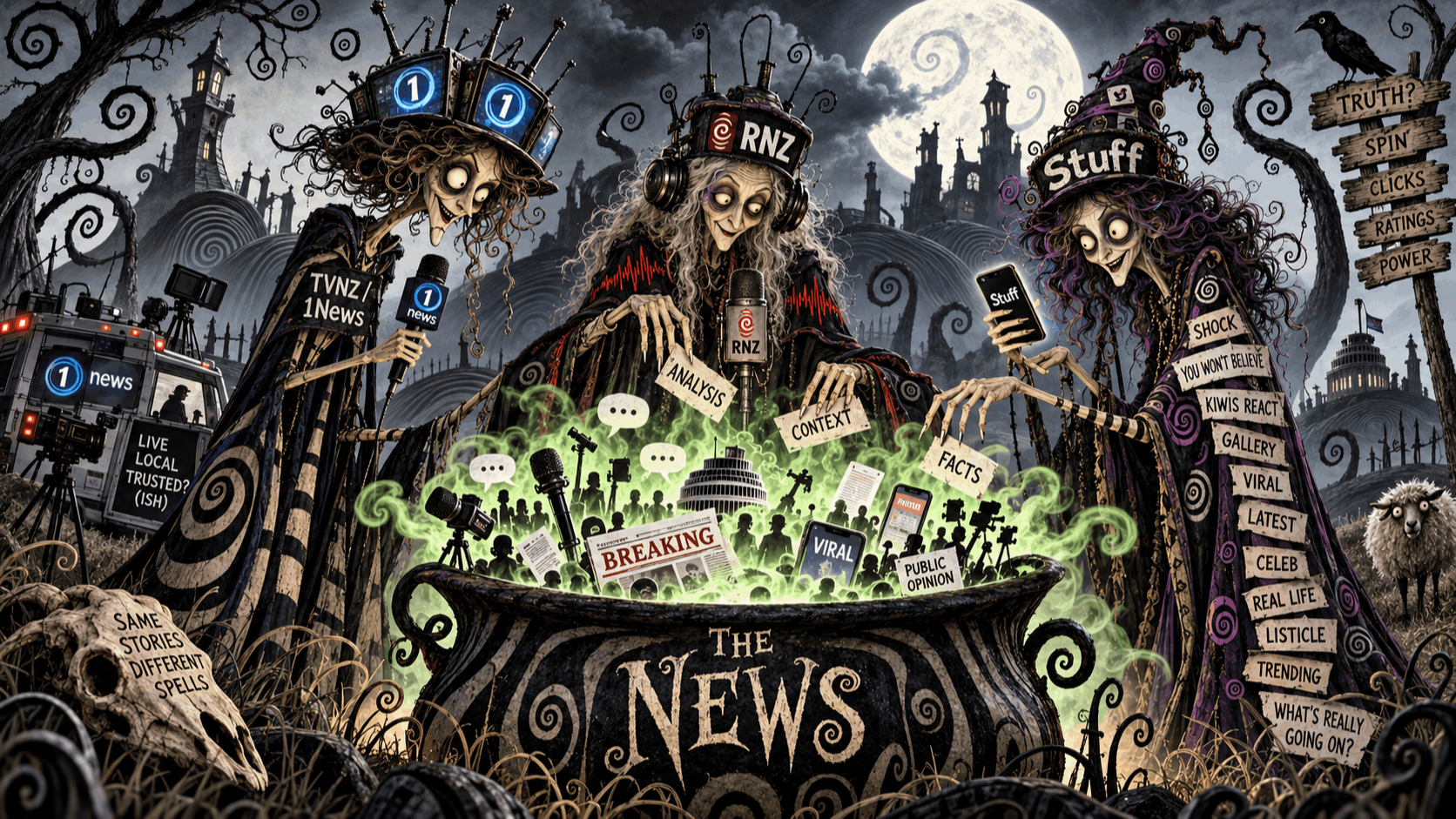
Rank Overused phrases - Why they are tired.
1 In shock / town in shock / community shocked
Used for everything from tragedy to a golf course sale. Often means “some people are upset.” 1News recently used “shocked and devastated” for Pegasus residents after a golf course sale.
2 Breaking news
Usually not breaking by the time you read it. Often means “we have published a thing.”
3 Crisis
Housing crisis, cost-of-living crisis, health crisis, fuel crisis, confidence crisis. Sometimes true, often just headline steroids.
4 Shock
Political shock, economic shock, selection shock, weather shock. 1News used “shock departure” for a rugby story and “cost shock” for economic impacts.
5 Devastated / heartbreaking
Emotional boilerplate. Frequently used before the reader knows whether devastation is justified or just disappointment wearing mascara.
6 Hammered / slammed / blasted
Weather hammers, politicians slam, critics blast. The verbs are exhausted and need a lie-down.
7 Game of two halves
Sports cliché so old it should qualify for SuperGold. Usually means “one team was better for a while, then the other team was better.”
8 Physicality
Rugby/media filler meaning “large humans ran into other large humans.”
9 Learnings
Corporate-sports-news sludge. The word is “lessons.” “Learnings” sounds like a workshop trapped in a spreadsheet.
10 Sparked outrage / backlash / fury
Often based on three social-media posts, one lobby group, and a journalist needing a headline by 4pm.
Honourable mentions
Under fire — often means someone has been mildly criticised.
Calls are growing — by whom, exactly? Two councillors and a Facebook group?
Experts warn — sometimes useful, sometimes a panic hat on a press release.
Kiwis are being warned — the national media’s favourite doorbell.
Revealed — usually means “announced.”
Chaos — often means “delay.”
Battle / showdown / war of words — usually two people disagreeing in emails.
Plunges / soars — useful for finance, ridiculous for a 2% change.
Miracle / nightmare — tabloid seasoning.
A community reeling — journalistic incense.
MEGA’s headline rule
If the headline says shock, crisis, outrage, devastated, or breaking, subtract 40% drama immediately.
If it says learnings, close the tab and seek fresh air.
Are we building shared identity, or just replacing one dominance with another?
MEGA supports respecting Māori names where they have deep historical meaning. We also support keeping familiar English names where they have earned their place in community memory.
And if we are serious about partnership, then naming should not be a one-way cultural escalator.
It should be honest, balanced, explained properly, voted on where appropriate, and used to unite people — not make half the country feel as if their history is being quietly painted over with a council-approved koru.
Partnership means both hands on the wheel.
At the moment, place naming often looks like one hand driving and the other hand writing a funding application.
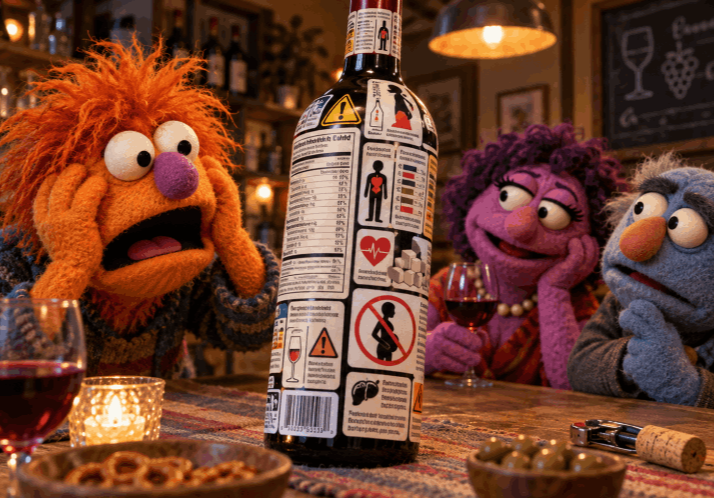
In Defence of the Eastbourne Drinker
The latest health sermon says alcohol is bad, pleasure is suspicious, and anyone enjoying a glass of wine should be monitored by a committee.
MEGA disagrees.
Nobody is suggesting breakfast gin or replacing the town water supply with pinot gris. But moderate drinking is not a public emergency. A beer after gardening, a wine with dinner, or a whisky after opening the rates bill is not social collapse. It is civilisation.
The science is not as simple as the finger-waggers pretend, and adults deserve balanced information, not moral panic with a clipboard.
Eastbourne’s real health threat is not one glass of red. It is loneliness, boredom, over-regulation, and the slow death of places where people gather, laugh, argue and complain about Wellington face to face.
Drink sensibly. Know your limits. Avoid becoming the village cautionary tale.
MEGA says: Cheers to common sense.
Read between the lines.
Labour wants to scrap National’s primary school testing tool because, apparently, parents knowing whether their child can read, write and do basic maths is now a radical right-wing experiment.
MEGA’s view is simple: test the basics, tell the parents, help the child.
This is not cruelty. It is called knowing what is going on.
If a school system is nervous about measuring literacy and numeracy, the problem is not the test
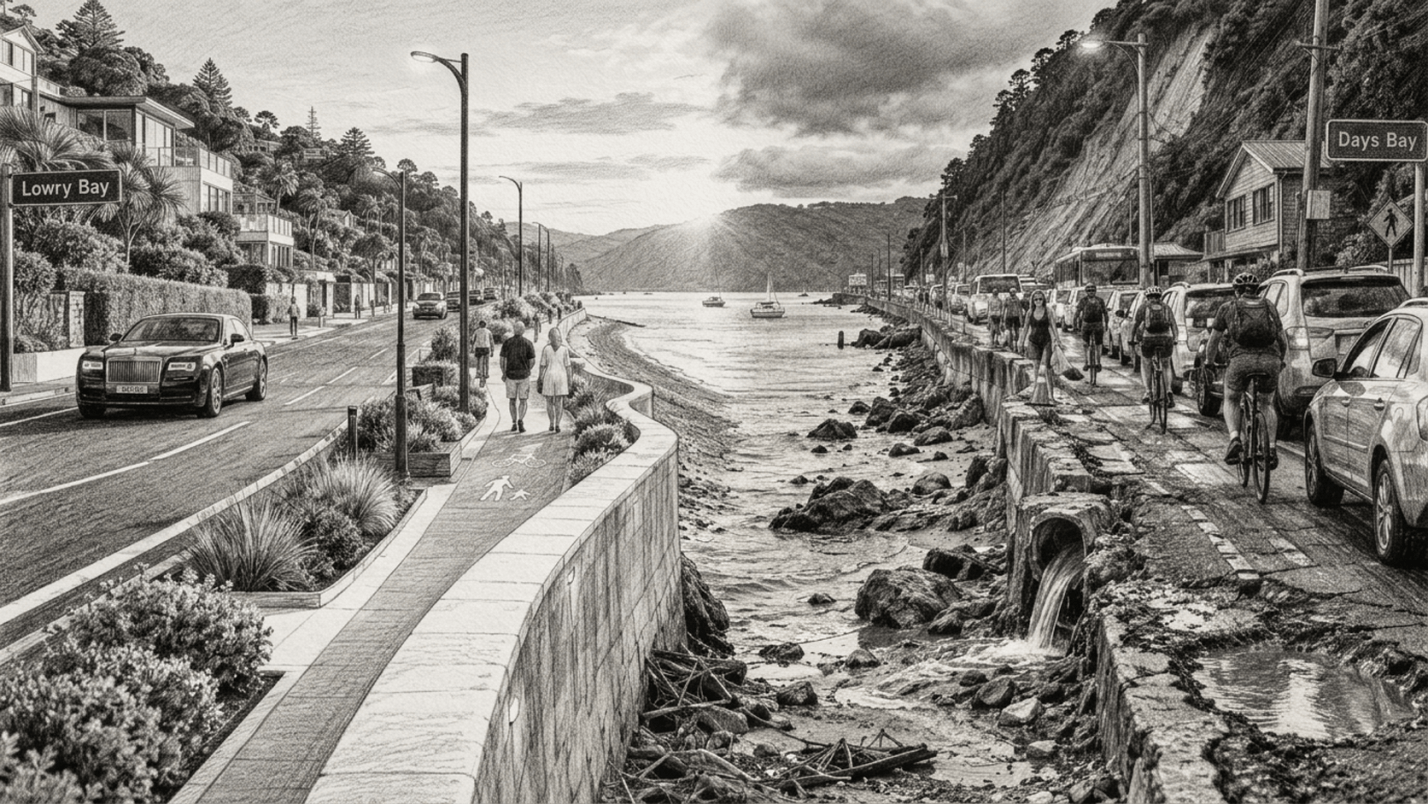
Ferry Road has again produced the sort of discovery no neighbourhood should have to make: suspected faecal matter seeping from beneath the roadway.
This is not a minor pothole. This is not a cosmetic crack. This is not “monitoring the situation” territory. This is a possible wastewater, drainage, road-base or subsurface infrastructure failure.
And Hutt City Council and Wellington Water have already been told.
Ferry Road has a long history of road deterioration, cracking, drainage issues, subsurface water problems and localised failures. Residents have raised concerns before. The response has too often felt like the familiar civic routine: acknowledge, delay, deflect, disappear.
Meanwhile, the road keeps talking.
MEGA’s view is simple: if sewage, foul water or faecal contamination is appearing from under a public road, the response should be immediate, visible and serious.
Not silence. Not buck-passing.
Not “we’ll get back to you”.
HCC and Wellington Water need to inspect properly, test the seepage, identify the source, advise affected residents, and explain what is being done.
Ratepayers should not have to become unpaid sewage detectives.
MEGA also wants to hear from residents in Days Bay and Eastbourne: are there other roads or streets where similar leaks, smells, seepage, drainage failures, subsidence or wastewater concerns have been reported — and left unresolved?
If so, say so.
Quiet complaints vanish into inboxes. Loud ratepayers get heard.
It is time to yell.
As the current FIFA World Cup thunders across North America with 48 teams, 104 matches, giant stadiums, hydration breaks, VAR checks, tactical collapses, theatrical injuries and commentators saying “physicality” every nine minutes, MEGA feels it is time to remind the world of something important.
None of this chaos would work properly without a little Kiwi invention.
The referee’s whistle.
Not the whistle itself, to be pedantic, because someone will be. But the use of a whistle to control a sports match is widely credited to William Harrington Atack, a New Zealander from Canterbury. In 1884, while refereeing rugby, Atack reportedly decided yelling at players was about as useful as asking a possum to observe road rules. He had a whistle, used it, and sport was never the same again.
Before that, referees largely shouted, waved, gestured and hoped large sweaty men would notice.
Imagine the World Cup without it.
No sharp blast to stop a tackle. No shriek for offside. No dramatic penalty moment. No referee standing in the middle of 70,000 screaming people trying to restore order with the vocal power of a disappointed librarian.
Without Atack’s idea, modern football would require referees to bellow things like:
“Excuse me, Brazil, that was a foul.”
“Germany, please stop arguing.”
“Sir, kindly remove your elbow from Uruguay.”
That is the beauty of it.
A New Zealander helped give sport one of its simplest and most powerful tools: a way for one person to bring twenty-two players, three assistant referees, a bench full of emotional millionaires, and an entire stadium of armchair experts to a halt.
New Zealand may not win every World Cup.
But we did help invent the thing that tells everyone else when to stop making a mess of it.
Chef Gordon Ramswine
The pig with a palate sharper than his tongue. Known for turning slop into haute cuisine and never holding back on a fiery snort of criticism, Ramswine runs the kitchen like a battlefield. His signature dishes? Swine-dine perfection, seasoned with equal parts brilliance and barnyard bite.
Each month he delivers a new and original offering for you to try. If you like the dish then please let us know.
Gordon Ramswine’s
MEGA JUNE RECIPE
By Chef Gordon Ramswine
The Wellington Blackout Pudding
JUNE 2026 Our MEGA Mid-Winter Dessert
What it is:
A dark, dramatic, slightly ridiculous mid-winter dessert: warm black cocoa pudding, salted feijoa-caramel centre, toasted walnut rubble, whisky-orange cream, and a “power cut” black sugar shard stuck in the top.
It looks like Wellington after 6pm in July, but tastes considerably better.
Meet Stuffed.Kiwi — where our music lives, our videos escape to, and original Stuffed Kiwi productions do their thing.
No messaging. No meaning. Just fun.
We’re not a political party—just a bunch of locals with a low tolerance for waffle and a high tolerance for mischief. MEGA is part neighbourhood fix-it crew, part satire squad, and part spontaneous parade.
No jargon. No committees. Just Eastbourne, steering its own ship—with a kazoo in one hand and a to-do list in the other.
For the full MEGA experience, visit our website on something bigger than your phone.
© Copyright 2026 M.E.G.A. - All Rights Reserved - Make Eastbourne Great Again Inc.
Join the MEGA-VERSE:
The MEGA Management & Crew is looking for more members to join our organisation.
Also Join our Facebook Group [ icon click on the right ] and contribute to the conversation.
It's Free. No Censorship. No Judgement (almost).
Help us Make the MEGA-VERSE Even Bigger Than It Is Already.